
At The Brain and Spine Centre, we specialize in the diagnosis and surgical treatment of neurological and spinal disorders. Dr. Muhammad Aqeel Natt, a leading neurosurgeon in Lahore, provides advanced, safe, and compassionate care for patients.
Meningiomas
Meningioma requires prompt, expert diagnosis and individualized treatment to manage this brain tumor effectively. At The Brain and Spine Centre, Dr. Muhammad Aqeel Natt provides specialized care for meningiomas at Farooq Hospital, West Wood Branch, Lahore, combining advanced neurosurgical expertise with compassionate support.
Our goal is simple: remove or stabilize tumor safely, preserve neurological function, and guide recovery for the best possible quality of life.
What Is a Meningioma?
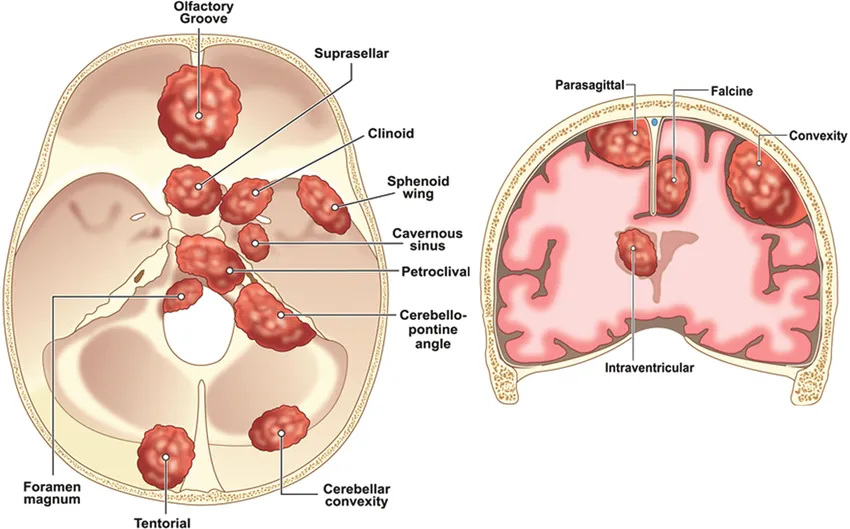
A meningioma is a tumor that grows in the meninges, the thin layers of tissue that cover and protect the brain and spinal cord. Most meningiomas are not cancerous (benign), representing approximately 27% of all brain tumors diagnosed. Meningiomas are graded from Grade I (benign, slow-growing) to Grade III (malignant, fast-growing), with the grade determining growth rate and treatment approach. These tumors are more common in women than men and typically develop between ages 40 and 60.
Symptoms of Meningioma
Meningioma symptoms depend on tumor size and location and may develop gradually over months or years. Many small meningiomas cause no symptoms and are discovered incidentally on imaging performed for other reasons.
Common meningioma symptoms include:
Headaches, particularly worse in the morning, seizures or convulsions, weakness or paralysis in arms or legs, loss of eyesight or vision problems, hearing loss or ringing in the ears, nausea and vomiting, cognitive changes including trouble thinking clearly or memory problems, trouble walking, balance difficulties, or coordination problems, facial numbness or altered sensation, and personality or behavior changes.
Diagnosis
Diagnosis begins with neurological examination testing balance, vision, and cognitive function. Imaging studies confirm diagnosis and guide treatment planning.
Imaging options include:
Magnetic Resonance Imaging (MRI) is the imaging study of choice for evaluation of meningiomas. MRI provides highly detailed images of soft tissue and helps distinguish meningioma characteristics. Advanced MRI techniques including diffusion and perfusion imaging provide insights into tumor behavior.
Computerized Tomography (CT) scan is more widely available and better suited for rapid screening. CT is superior at demonstrating bony changes, including hyperostosis and cortical irregularity, and detecting calcifications within the tumor.
Biopsy may be performed during surgery or via needle biopsy to confirm diagnosis and determine tumor grade.
Treatment Options
Observation (Watch and Wait): Most meningiomas are asymptomatic and benign, making observation a reasonable first-line approach. About 80% of meningiomas are benign, and approximately 51% of incidentally discovered meningiomas are managed with active monitoring rather than immediate surgery. Asymptomatic, slow-growing tumors are followed with serial MRI imaging annually or every 1-2 years. An initial MRI at 6 months after diagnosis, followed by annual monitoring, is recommended to detect growth. Treatment is initiated if symptoms develop, sustained tumor growth occurs, or the tumor approaches critical structures.
Surgery: The most common treatment for symptomatic meningiomas is surgical resection. The neurosurgeon removes as much tumor as possible without damaging critical brain functions through careful surgical planning and intraoperative monitoring. Complete tumor removal (gross total resection) offers the best long-term outcomes.
Radiation therapy: Radiation is used for incompletely resected tumors, recurrent tumors, or atypical/malignant meningiomas to prevent regrowth. Stereotactic radiosurgery precisely focuses radiation beams on the tumor in single or few sessions with minimal impact on surrounding tissue. Conventional radiation therapy is typically delivered once daily, five days a week, for several weeks.
Rehabilitation: Following surgery, rehabilitation restores function and quality of life. Physical and occupational therapy address motor deficits and activities of daily living, while cognitive rehabilitation improves memory and concentration.
The Procedure
Our process safeguards safety, neurological preservation, and optimal outcomes:
Consultation: Comprehensive neurological evaluation and imaging review to assess tumor characteristics, location, symptoms, and surgical feasibility.
Imaging: Advanced MRI with or without contrast, CT scans, and possibly additional studies to determine tumor grade, size, relationship to critical brain structures, and vascular involvement.
Treatment decision: Based on tumor grade, extent of symptoms, and patient preference, the plan may involve observation with surveillance imaging, surgical resection, radiation therapy, or combination treatment.
Surgery (if indicated): Carefully planned craniotomy using intraoperative monitoring and imaging to achieve maximal tumor resection while protecting critical neurological functions.
Recovery: Inpatient monitoring, early mobilization, and initiation of rehabilitation therapies.
Recovery & Aftercare
Recovery varies based on tumor grade, surgical extent, and symptoms. Most patients admitted to rehabilitation treatment average approximately 24 days before discharge. Approximately 91.7% of meningioma patients are discharged to their homes, with only 3.4% requiring nursing home care. Physical and occupational therapy promote restoration of strength, balance, and activities of daily living. Cognitive rehabilitation addresses memory, concentration, and attention difficulties that may persist months to years after treatment. Patients may report fatigue and sleep impairment requiring ongoing management support.
Results You Can Expect
Grade I benign meningiomas demonstrate excellent outcomes, with 5-year progression-free survival of 95.7% and 10-year survival of 90.4%. Complete resection offers the best prognosis, with only 10% recurrence at 5 years and 20% at 10 years, with no recurrence beyond 11 years of follow-up.
Grade II atypical meningiomas have 5-year progression-free survival of 68.4%, with 24% recurrence at 5 years and 50% at 10 years.
Grade III malignant meningiomas have 5-year progression-free survival of 46.7%, with 62% recurrence at 5 years and all recurred by 10 years.
Overall outcomes include tumor removal or stabilization, preservation of neurological function, and return to daily activities and work for most patients.
Why Choose The Brain and Spine Centre
Led by Dr. Muhammad Aqeel Natt, specialist neurosurgeon with extensive expertise in meningioma surgery and brain tumor management. Access to advanced imaging including high-field MRI for precise preoperative planning and diagnosis. Individualized treatment approach with options for observation, surgery, and radiation therapy based on tumor grade and patient preference. Multidisciplinary team coordinating neurosurgery, neuro-oncology, and rehabilitation services. Convenient location at Farooq Hospital, West Wood Branch, Lahore with state-of-the-art operating capabilities.
Cost of Glioma Treatment
Costs vary with tumor grade, extent of surgical resection, need for radiation therapy, duration of hospitalization, and rehabilitation services. Personalized estimates provided after consultation and imaging evaluation.
Frequently Asked Questions (FAQs)
Can I know Dr. Muhammad Aqeel Natt’s credentials?
What types of brain tumours do you treat?
Is the surgery safe?
Do I need long-term follow-up after surgery?
Are you having health problems? Contact us today!
Address Business
Contact With Us
Call Us 24/7: 0318 4065914
Working Time
Sunday: 8.30am - 19.30pm
