
At The Brain and Spine Centre, we specialize in the diagnosis and surgical treatment of neurological and spinal disorders. Dr. Muhammad Aqeel Natt, a leading neurosurgeon in Lahore, provides advanced, safe, and compassionate care for patients.
Carries Spine / Spinal TB
Caries spine (spinal tuberculosis, Pott’s disease) is a destructive TB infection of the vertebral column that can cause spinal instability, deformity, and paralysis if not treated promptly. At The Brain and Spine Centre, Dr. Muhammad Aqeel Natt provides comprehensive management of spinal TB at Farooq Hospital, West Wood Branch, Lahore, combining early diagnosis, full-course anti‑tuberculous therapy (ATT), and carefully selected spinal surgery with modern instrumentation when needed.
Our goal is simple: eradicate infection, prevent or reverse neurological deficits, and correct or limit spinal deformity to preserve function and quality of life.
What Is Caries Spine / Spinal TB?
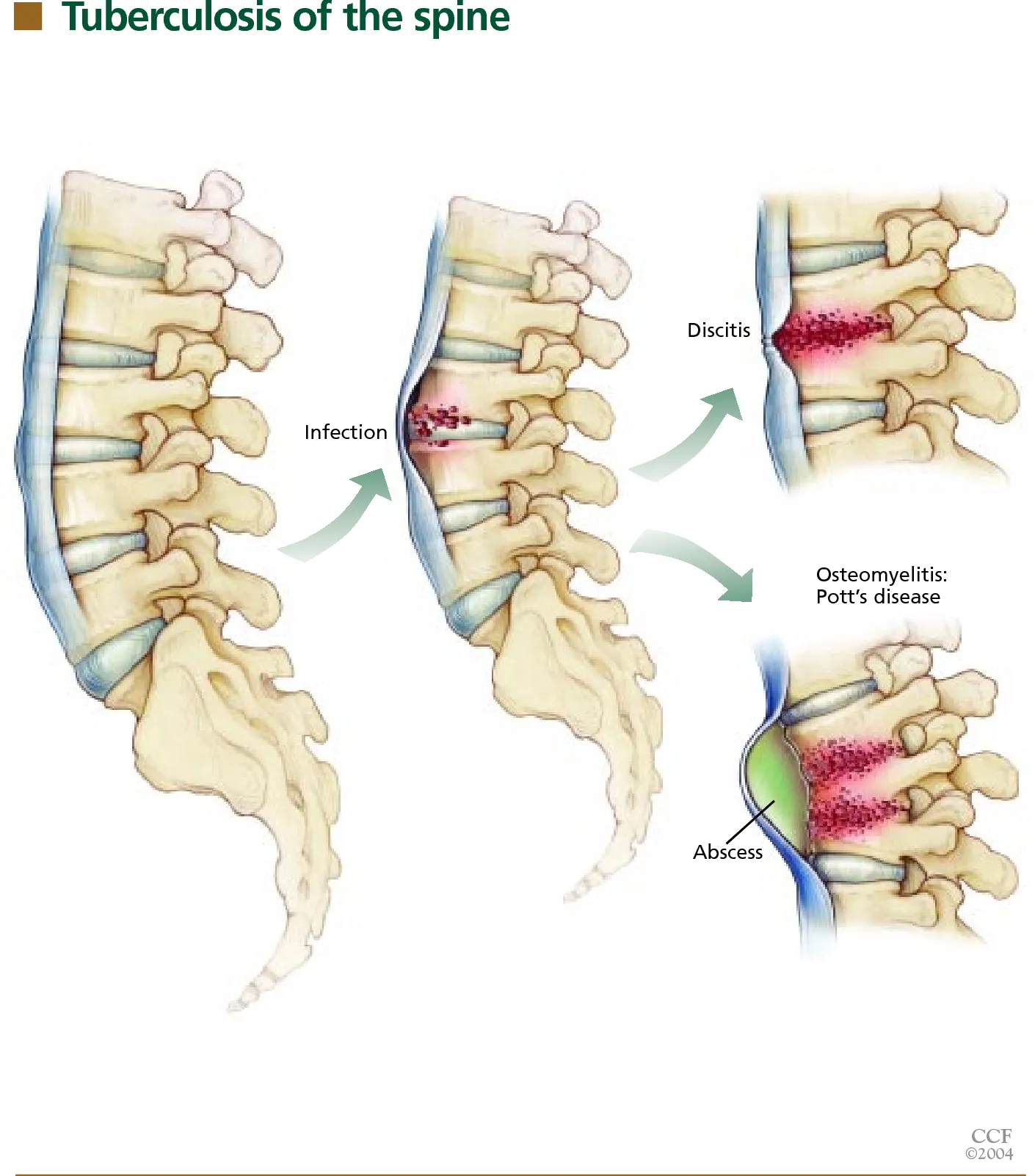
Spinal tuberculosis is the most common form of skeletal TB and accounts for about 50% of osteoarticular TB cases. It usually involves the anterior part of the vertebral bodies, often affecting two adjacent vertebrae with destruction of the intervertebral disc and collapse, leading to kyphotic deformity. Infection typically spreads hematogenously from a primary pulmonary or extra‑pulmonary focus.
If untreated, progressive vertebral collapse, abscess formation, and epidural granulation tissue can compress the spinal cord, causing paraplegia or quadriplegia.
Symptoms of Spinal TB
Clinical presentation is often insidious.
Common features:
Persistent, localized back pain (most common early symptom), often worse at night and at rest; “rest pain” is characteristic.
Local tenderness and paraspinal muscle spasm; limited spinal movement in all directions.
Constitutional symptoms: low‑grade fever, night sweats, weight loss, malaise.
Progressive kyphotic deformity and gibbus formation, especially in thoracic and thoracolumbar spine.
Neurological deficits: radicular pain, weakness, sensory loss, and in advanced cases paraplegia or quadriplegia from cord compression, instability, or deformity.
Cold abscess formation with paraspinal or psoas swelling; may track along fascial planes to present distally.
Diagnosis
Early diagnosis relies on imaging and microbiology.
X‑rays show late changes: loss of disc height, vertebral body destruction, anterior wedging, and kyphosis, but are insensitive early.
MRI is the gold standard, showing early marrow oedema, disc involvement, epidural and paravertebral abscesses, and neural compression; it also helps distinguish TB from pyogenic spondylitis (thin, smooth abscess wall, large paraspinal collections). MRI is best to assess cord and nerve root integrity and detect distant asymptomatic disease.
CT better shows bony destruction, sequestra, and calcification within abscesses, and guides biopsy.
Microbiological confirmation: CT‑guided or open biopsy with histopathology, AFB smear, culture, and PCR (GeneXpert) confirms TB and drug sensitivity.
Treatment Options
First‑line treatment is medical; surgery is reserved for specific indications.
Anti‑tuberculous therapy (ATT):
Standard multi‑drug ATT (e.g., isoniazid, rifampicin, pyrazinamide, ethambutol) for 6–9 months is recommended in most guidelines, with some favouring extended regimens (9–12+ months) depending on response and national protocols.
Most patients with uncomplicated spinal TB (no major neurological deficit or deformity risk) can be managed successfully with ATT alone and bracing.
Surgical indications (complicated disease):
Progressive or severe neurological deficit not improving with ATT.
Spinal instability or severe/progressive kyphotic deformity, especially in children and thoracic/thoracolumbar lesions.
Large paravertebral or epidural abscess causing cord/nerve root compression or not responding to medical therapy.
Uncertain diagnosis requiring open biopsy and decompression.
Surgical options:
Anterior debridement, decompression, and fusion with or without instrumentation.
Posterior decompression and instrumented fusion (transpedicular approach) to correct deformity and stabilise spine; studies show it is safe and effective, improving kyphosis and enabling early mobilisation.
Minimally invasive or thoracoscopic approaches (VATS) for selected thoracic lesions, allowing debridement and fusion with less morbidity.
Surgery is always combined with full‑course ATT.
The Procedure
At The Brain and Spine Centre:
Assessment: MRI and CT define disease extent, neural compression, and deformity; lab tests and biopsy confirm TB and sensitivity pattern.
Medical phase: initiation or continuation of ATT, analgesia, bracing, and nutritional support for all patients.
Surgical phase (if indicated):
Decompression of spinal cord and nerve roots by removing infected vertebral body/disc and draining abscess.
Anterior, posterior, or combined instrumentation with bone grafting to reconstruct and stabilise the spinal column, correct kyphosis, and allow early sitting and ambulation.
Recovery & Aftercare
ATT is continued for the full recommended duration, with clinical and radiological monitoring; most cases show progressive pain relief, improved mobility, and radiological healing.
Bracing and early physiotherapy support posture, prevent contractures, and strengthen paraspinal and limb muscles.
Neurological recovery may take months and depends on preoperative deficit duration and severity.
Regular follow‑up with MRI/CT or X‑ray tracks fusion, deformity correction, and absence of reactivation.s
Results You Can Expect
With timely and appropriate treatment:
The majority of patients achieve infection control, pain relief, and stable fusion without recurrence.
Instrumented stabilisation combined with ATT corrects kyphosis (e.g., from mean ~21° to ~9° in one series) with minimal loss of correction at follow‑up and excellent neurological outcomes.
Neurological recovery rates are high when surgery is performed before irreversible cord damage; many patients with paraparesis recover to independent ambulation.
Why Choose The Brain and Spine Centre
Led by Dr. Muhammad Aqeel Natt, with extensive experience in spinal TB decompression, anterior/posterior instrumentation, and deformity correction. Use of MRI and CT to detect early spinal TB, map epidural and paravertebral extension, and plan the safest decompression and stabilisation strategy. Evidence‑based selection between purely medical therapy and surgery, following contemporary indications to minimise neurological disability and deformity. Coordinated care with infectious disease specialists, physiotherapists, and rehabilitation teams for optimal long‑term outcomes.
Cost of Spinal TB Treatment
Costs depend on disease severity, need for surgery and instrumentation, hospital stay length, ATT duration (often many months), and physiotherapy/rehabilitation. Detailed cost estimates are provided after imaging and clinical assessment.
Frequently Asked Questions (FAQs)
Can I know Dr. Muhammad Aqeel Natt’s credentials?
What types of brain tumours do you treat?
Is the surgery safe?
Do I need long-term follow-up after surgery?
Are you having health problems? Contact us today!
Address Business
Contact With Us
Call Us 24/7: 0318 4065914
Working Time
Sunday: 8.30am - 19.30pm
