
At The Brain and Spine Centre, we specialize in the diagnosis and surgical treatment of neurological and spinal disorders. Dr. Muhammad Aqeel Natt, a leading neurosurgeon in Lahore, provides advanced, safe, and compassionate care for patients.

Microvascular Decompression
Microvascular decompression is a highly effective neurosurgical procedure that relieves severe facial pain and spasm by relieving vascular compression of cranial nerves at their brainstem exit zone. At The Brain and Spine Centre, Dr. Muhammad Aqeel Natt offers MVD surgery at Farooq Hospital, West Wood Branch, Lahore, using meticulous microsurgical techniques to achieve durable pain relief while preserving facial nerve function.
Our goal is simple: decompress the nerve, eliminate the source of pain or spasm, and restore quality of life.
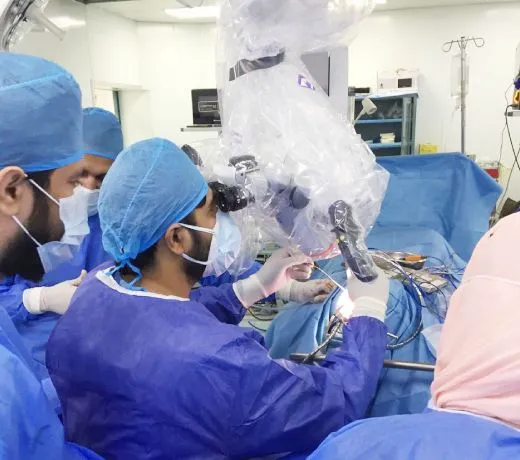
What Is Microvascular Decompression?
Microvascular decompression (MVD) is a microsurgical procedure that relocates or removes a blood vessel compressing a cranial nerve at the root entry or exit zone of the brainstem, which causes the nerve to misfire and produce symptoms. It treats the underlying vascular compression rather than damaging the nerve, making it a non-destructive technique with excellent long-term outcomes.
MVD is used to treat:
- Trigeminal neuralgia (TN): severe, shooting facial pain in the trigeminal nerve distribution.
- Hemifacial spasm (HFS): involuntary facial muscle twitching or spasms.
- Other cranial nerve compression syndromes such as glossopharyngeal neuralgia or superior laryngeal neuralgia.
Symptoms Addressed
- Trigeminal neuralgia:
- Severe, stabbing, electric shock-like pain in the cheek, jaw, or eye area, often triggered by light touch, chewing, or brushing teeth
- Pain in one or more divisions of the trigeminal nerve (ophthalmic V1, maxillary V2, mandibular V3)
- Attacks lasting seconds to minutes, with refractory periods between them
- Pain may be constant or episodic, worsening over time if untreated
- Hemifacial spasm:
- Involuntary, rhythmic facial muscle contractions affecting one side of the face
- Eyelid twitching (blepharospasm) often the first symptom
- Progressive worsening, often becoming disabling over time
The Procedure
- Patient positioned supine with head turned, exposing the cerebellopontine angle.
- A small retromastoid incision (2–3 cm) is made, and a limited craniotomy exposes the brainstem and cranial nerve root entry zone.
- Under the operating microscope, the offending vascular loop (most commonly the superior cerebellar artery in 75% of TN cases, or veins) is identified.
- The vessel is gently mobilized and relocated away from the nerve root, or a protective pledget (Teflon felt) is placed between the vessel and nerve to provide durable separation.
- Nerve combing and intraoperative neurolysis (“MVD Plus” technique) may improve outcomes by removing scar tissue and freeing nerve fibers.
- The wound is closed; ICU-grade dural closure minimizes CSF leak risk.
Recovery & Aftercare
- Hospital stay: 1–2 days or overnight observation in most cases.
- Pain relief: Approximately 87% of patients experience immediate, complete pain relief; nearly 93% maintain relief at 2 years.
- Early mobilization: Patients walk the day after surgery and resume light activities within 1–2 weeks.
- Numbness and temporary facial weakness: May occur but are usually mild and resolve over weeks to months.
- Long-term outcomes: Studies show ~80% chance of pain freedom with recurrence rates of approximately 10% over 10–20 years when performed by experienced surgeons.
Results You Can Expect
Trigeminal neuralgia:
- 88–89% of patients achieve good outcomes (Barrow Neurological Institute pain scores I–II) at long-term follow-up.
- 55–80% experience complete pain relief without medications.
- Additional 10–35% achieve partial pain relief, requiring reduced medication.
- Low recurrence rates (approximately 10% over 10–20 years) are significantly lower than percutaneous procedures (50% recurrence at 3–5 years).
Hemifacial spasm:
- High cure rates with complete spasm resolution in the majority of patients.
- Durable results with low recurrence rates.
Complications: Generally low overall, with facial hypoesthesia (numbness) and hearing loss being the most common, though usually mild and self-limited. Life-threatening complications occur in <2% of cases.
Why Choose The Brain and Spine Centre
Led by Dr. Muhammad Aqeel Natt, specialist neurosurgeon with extensive expertise in MVD and microvascular decompression techniques. Meticulous microsurgical technique with small incisions and minimal craniotomy to reduce facial nerve complications and improve cosmetic outcomes. Experience with the “MVD Plus” technique combining vessel relocation with intraoperative nerve combing for optimized outcomes. High-resolution preoperative imaging and careful patient selection to maximize long-term pain relief and minimize recurrence.
Cost of Microvascular Decompression
Costs vary with imaging studies, hospital stay, length of surgery, and postoperative monitoring. Personalized cost estimates provided after consultation and imaging review.
Frequently Asked Questions (FAQs)
Can I know Dr. Muhammad Aqeel Natt’s credentials?
What types of brain tumours do you treat?
Is the surgery safe?
Do I need long-term follow-up after surgery?
Are you having health problems? Contact us today!
Address Business
Contact With Us
Call Us 24/7: 0318 4065914
Working Time
Sunday: 8.30am - 19.30pm
