
At The Brain and Spine Centre, we specialize in the diagnosis and surgical treatment of neurological and spinal disorders. Dr. Muhammad Aqeel Natt, a leading neurosurgeon in Lahore, provides advanced, safe, and compassionate care for patients.
Radiofrequency Rhizotomy (RFR / RF Ablation)
Radiofrequency rhizotomy is a minimally invasive procedure that uses controlled heat to interrupt pain signals from the trigeminal nerve, providing effective relief for patients with severe facial pain. At The Brain and Spine Centre, Dr. Muhammad Aqeel Natt offers radiofrequency rhizotomy at Farooq Hospital, West Wood Branch, Lahore, delivering precise, targeted pain relief for patients with trigeminal neuralgia who cannot undergo or prefer to avoid open surgery.
Our goal is simple: interrupt facial pain signals safely, restore comfort, and improve quality of life with minimal downtime.
What Is Radiofrequency Rhizotomy?
Radiofrequency rhizotomy (RFR), also called percutaneous radiofrequency ablation, is a minimally invasive procedure that treats trigeminal neuralgia by using controlled thermal (heat) energy to selectively damage pain-transmitting nerve fibers of the trigeminal nerve at the Gasserian ganglion. A needle electrode is inserted through the cheek into the foramen ovale at the base of the skull, and radiofrequency current heats the nerve fibers, disrupting pain signals while aiming to preserve some sensation.
RFR is an ablative (destructive) procedure—it trades mild numbness for pain relief—and is particularly useful for patients who are elderly, medically unfit for craniotomy, have multiple sclerosis–related trigeminal neuralgia, or have recurrent pain after other treatments.
Symptoms Addressed
RFR is used to treat:
- Trigeminal neuralgia (TN): severe, stabbing, electric shock-like facial pain triggered by light touch, chewing, talking, or brushing teeth.
- Pain in one or more divisions of the trigeminal nerve (V1 ophthalmic, V2 maxillary, V3 mandibular).
- Drug-resistant facial pain that has failed adequate medical therapy.
- Recurrent pain after prior surgical treatments such as microvascular decompression or radiosurgery.
Diagnosis
Accurate diagnosis confirms trigeminal neuralgia and suitability for RFR.
- Clinical history and examination document characteristic lancinating, triggered facial pain in a trigeminal distribution.
- MRI excludes secondary causes such as tumors, vascular malformations, or demyelinating disease.
- CT scan may be used to visualize the foramen ovale and plan needle trajectory.
The Procedure
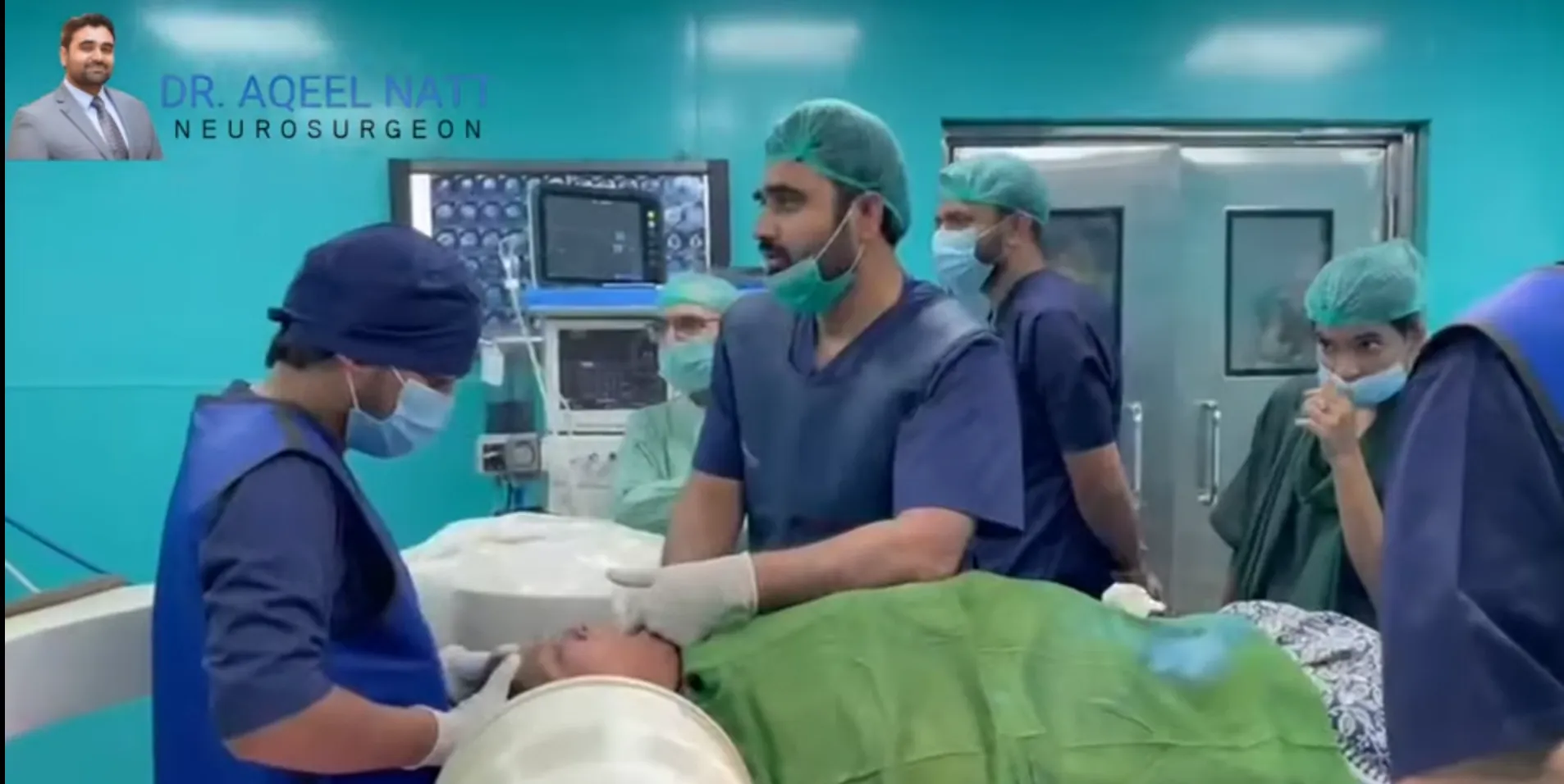
RFR is performed as an outpatient or short-stay procedure under sedation and local anesthesia.
Key steps:
- The patient is positioned supine; light sedation is administered.
- Under fluoroscopic or CT guidance, a needle electrode is inserted through a small puncture in the cheek and advanced into the foramen ovale to reach the Gasserian ganglion.
- The patient is briefly awakened for sensory stimulation testing (50 Hz) to confirm the electrode is positioned at the exact pain location; motor stimulation (2 Hz) confirms safe placement away from motor fibers.
- Once confirmed, the patient is sedated again, and controlled radiofrequency current (typically 60–90°C for 60–90 seconds) creates a thermal lesion to selectively damage pain-transmitting fibers.
- The procedure typically takes 30–60 minutes; patients are observed briefly and usually discharged the same day.
Recovery & Aftercare
Recovery is rapid with minimal downtime.
- Most patients go home the same day or after overnight observation.
- Pain relief is often immediate in most patients; some experience gradual improvement over days.
- Facial numbness is expected and intentional—the degree of numbness correlates with duration of pain relief.
- Temporary side effects may include cheek swelling, bruising, or jaw weakness; these typically resolve within days to weeks.
- Normal activities can usually resume within a few days.
Results You Can Expect
RFR provides excellent short-term and good long-term pain relief in properly selected patients.
Efficacy:
- Initial pain relief is achieved in 93–98% of patients.
- At 1 year, approximately 80–86% remain pain-free without medications.
- At 3 years, 52–80% maintain complete pain relief depending on lesion extent.
- At 6 years, 22–32% remain pain-free after a single procedure; repeat RFR achieves similar efficacy.
- Patients with denser postoperative numbness (analgesia/dense hypoalgesia) have lower recurrence rates than those with mild numbness.
Recurrence:
- Pain recurrence occurs in approximately 20–50% of patients within 5 years, but repeat RFR is effective and can be performed multiple times.
Complications:
- Facial numbness (32–79%)—expected and usually well-tolerated.
- Masseter weakness (4–14%)—usually temporary.
- Dysesthesia (uncomfortable abnormal sensation) (0.5–18%)—rarely severe.
- Corneal hypoesthesia/diminished reflex (especially with V1 involvement)—requires eye protection; corneal ulcer rare (<2%).
- Anesthesia dolorosa (painful numbness)—uncommon (0–5%).
- Complications are generally less frequent and less severe than with open surgery.
Why Choose The Brain and Spine Centre
Led by Dr. Muhammad Aqeel Natt, specialist neurosurgeon experienced in percutaneous radiofrequency rhizotomy for trigeminal neuralgia and other facial pain conditions. Precise fluoroscopic guidance and sensory/motor stimulation testing to ensure accurate electrode placement and optimal pain relief with minimal side effects. Suitable for elderly patients, those with multiple sclerosis, or patients unfit for craniotomy, and as a treatment option for recurrent pain after MVD or radiosurgery. Outpatient or short-stay procedure with rapid recovery, allowing quick return to normal activities.
Cost of Radiofrequency Rhizotomy
Costs vary with imaging requirements, sedation type, hospital stay, and need for repeat procedures. Personalized cost estimates provided after consultation and imaging review.
Frequently Asked Questions (FAQs)
Can I know Dr. Muhammad Aqeel Natt’s credentials?
What types of brain tumours do you treat?
Is the surgery safe?
Do I need long-term follow-up after surgery?
Are you having health problems? Contact us today!
Address Business
Contact With Us
Call Us 24/7: 0318 4065914
Working Time
Sunday: 8.30am - 19.30pm
